Tou Sun (透榫): The Through Tenon in Chinese Furniture and When It Was Used
Tou sun · 明榫 · 通榫
On some Chinese chairs and tables you can see little rectangles of end grain on the face of a leg. Each one is the end of a tenon that has gone all the way through.
That is a tou sun, a through tenon, and where it shows tells you a lot about how a piece was made.
- Chinese
- 透榫 · tòu sǔn
- Also called
- 明榫, 通榫
- Joins
- Rail to post, frame members
- Found in
- Small faces of chairs and tables; frame corners
- Opposite
- Blind tenon (半榫)
How it works
All the way through
The mortise is cut right through the post and the tenon is as long as the post is deep, so its end grain shows on the far side.
Strong but less neat
Wang Shixiang: through tenons are stronger, but not as neat as blind ones. So tenons on the main show faces are usually blind, and those on the small faces through, though some pieces use through tenons everywhere.
Wedged
A saw cut can be made near the end of a through tenon and a wedge driven in after assembly, swelling the tenon tight. This is common at the corners of frame tops, chair seats and bed frames.
How it's made
 Step 1
Long tenon
Cut the tenon as long as the post is deep.
 Step 2
Through mortise
Cut the mortise right through the post.
 Step 3
Drive it in
Drive the rail in.
 Step 4
End grain shows
The tenon’s end grain shows on the far side.
 Step 5
Strong
A through tenon is stronger than a blind one.
 Step 6
Where it goes
Usually on the small, less visible faces.
Variations
Wedged through tenon
A wedge driven into a saw cut swells the tenon tight.
Big in, small out
Only part of the tenon runs through (大进小出).
Related joints
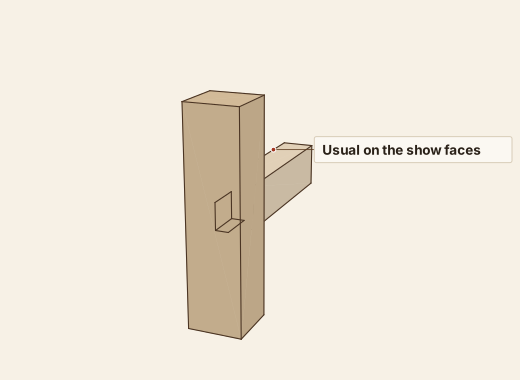
Blind Tenon (半榫)
The tenon stops inside the post, so nothing shows on the outside: neat, a little less strong than a through tenon.
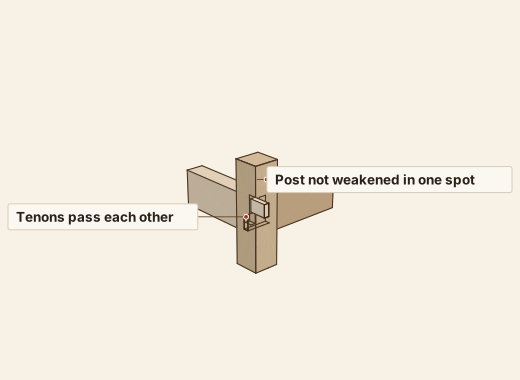
Big-In, Small-Out Tenon (大进小出榫)
Part blind, part through: a big tenon enters, a small one shows. It lets two stretchers share a leg without weakening it.
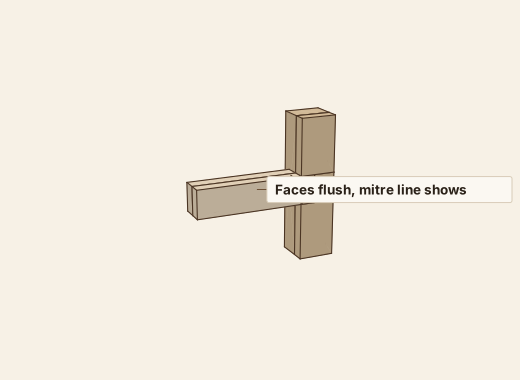
Mitred-Shoulder Joint (格肩榫)
Where a rail meets a post, its outer face is cut to a point that fits a matching notch, so mouldings meet cleanly.
Questions
What is a through tenon?
A tenon that passes right through its mortise so its end grain shows on the other side.
Is it stronger than a blind tenon?
Yes, but less neat, so fine makers kept it to the small faces.
How is it locked?
Often with a wedge driven into a saw cut in the tenon end.