Dajin Xiaochu (大进小出): The Half-Through Tenon of Chinese Cabinets and Buildings
Dajin xiaochu · Half-through tenon
A through tenon is strong, but it chops a big hole through the leg. When two stretchers meet a cabinet leg at the same height, two such holes would leave the leg hollow.
The dajin xiaochu, “big in, small out”, solves it: each tenon is big where it enters and only a small part runs through.
- Chinese
- 大进小出 · dàjìn xiǎochū
- Joins
- Rails or beams to a post
- Found in
- Cabinet base stretchers; beams in timber buildings
- Signature parts
- Blind part · through part
- Purpose
- Lets two tenons pass each other
How it works
Big in, small out
Part of the tenon is a blind tenon and stops inside; part is a through tenon and shows on the far face. The area entering the mortise is large, the area showing is small.
Two stretchers, one leg
Wang Shixiang’s example is a cabinet base, where front and side stretchers meet the leg at the same height. The side stretcher cuts away the lower half of its tenon and keeps the upper half through; the front one does the opposite. The tenons pass each other, the leg is not hollowed out, and both sides still get strong through tenons.
In buildings
Timber buildings use the same joint where tie beams enter columns.
How it's made
 Step 1
Blind part
Cut the large part of the tenon to stop inside the post.
 Step 2
Through part
Leave a smaller part that runs right through.
 Step 3
The other stretcher
Make the second stretcher the other way round: lower half through.
 Step 4
Fit both
Bring both stretchers to the post at the same height.
 Step 5
Through ends
On the outside only small tenon ends show.
 Step 6
Shared leg
The tenons pass each other and the post isn’t weakened in one spot.
Variations
Cabinet base stretchers
Both stretchers big-in-small-out, halved the opposite way.
Through and blind
Alternatively the front stretcher goes through and the side one stays blind, with the apron below the side stretcher tenoned through instead.
In museum collections
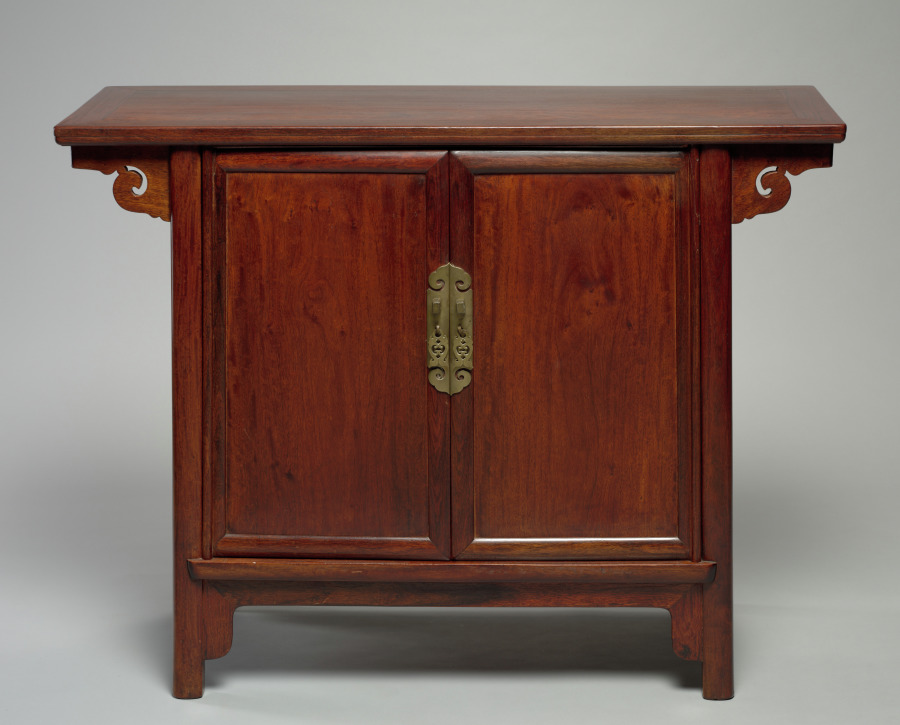
Cleveland Museum of Art
Related joints
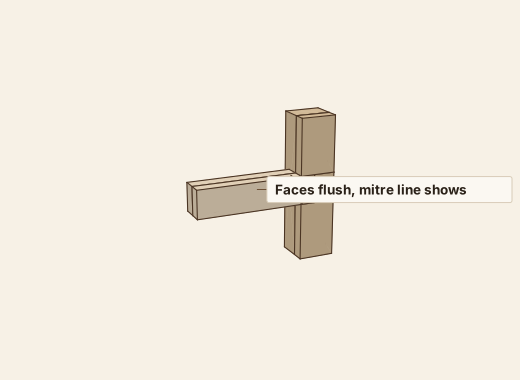
Mitred-Shoulder Joint (格肩榫)
Where a rail meets a post, its outer face is cut to a point that fits a matching notch, so mouldings meet cleanly.
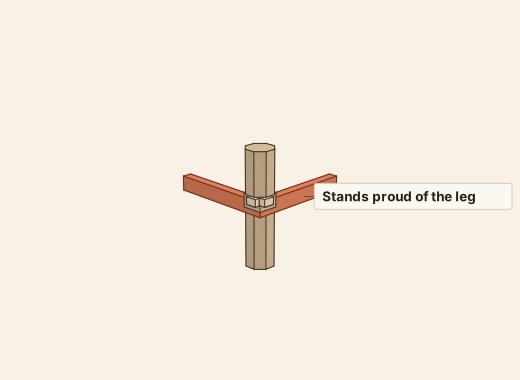
Wrap-Around Stretcher (裹腿枨)
Stretchers stand proud of a round leg and meet in a mitre at the corner, imitating bent bamboo.
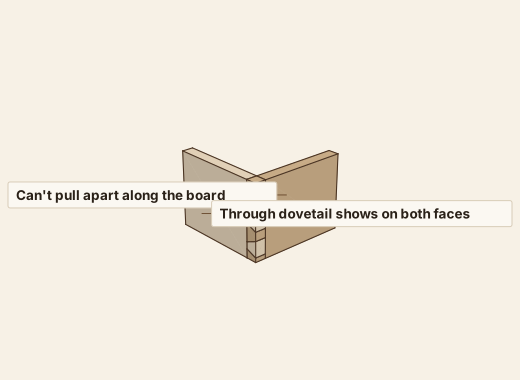
Dovetail Joint (燕尾榫)
A tenon wider at the tip than at the root, so it can’t pull out: found in boxes, drawers, tables and temple beams.
Questions
What does dajin xiaochu mean?
Big in, small out: a tenon that is large where it enters and only partly comes through.
Why use it?
So two tenons can share a post without cutting it away too much, while still showing through tenons.
Is it used in buildings?
Yes, for tie beams entering columns.