Gejian Sun (格肩榫): The Mitred-Shoulder T-Joint of Ming Chairs and Tables
Gejian sun · Mitred-shoulder mortise and tenon
Look where a stretcher meets a leg on a fine Ming chair. You don’t see a square butt. You see a crisp diagonal line, as if the two pieces were mitred like a picture frame.
That is the gejian sun, the mitred-shoulder joint, and Wang Shixiang used it as a mark of quality: the best chairs use it on all four sides.
- Chinese
- 格肩榫 · géjiān sǔn
- Joins
- Rail to post at a T
- Found in
- Chairs, tables, cabinets, bed railings
- Signature parts
- Pointed shoulder · matching notch · central tenon
- Variants
- Large and small shoulders; solid and split
How it works
The point and the notch
The rail’s outer half is cut to an isosceles point; the post’s outer half gets a matching V notch. The tenon stays in the middle and goes into a mortise. On the face you see only a mitre line, and the two surfaces run flush.
Large and small
The full point is the large shoulder, which the Song building manual 营造法式 calls 撺尖入卯. The small shoulder cuts the tip off, so less wood is chopped out of the post and it stays stronger.
A sign of quality
Wang observed that fine Ming and early-Qing chairs mostly use mitred shoulders on all four sides. Rougher ones use them only on the front, and the roughest use plain square shoulders throughout.
How it's made
 Step 1
Cut the point
Cut the outer half of the rail end to an isosceles point.
 Step 2
Leave the tenon
Leave the tenon in the middle of the rail end.
 Step 3
Notch the post
Cut a matching V notch in the post’s outer half.
 Step 4
Cut the mortise
Chop the mortise for the tenon.
 Step 5
Fit the rail
Drive the rail into the post.
 Step 6
Flush faces
The faces run flush, with only a mitre line showing.
Variations
Small shoulder
The point is cut off so the post loses less wood.
Split shoulder
The point is separated from the tenon by a slot (虚肩), adding glue area; good on thick stock, weakening on thin.
Square shoulder
No mitre at all (齐肩膀); a sign of simpler work when faces are flush.
In museum collections
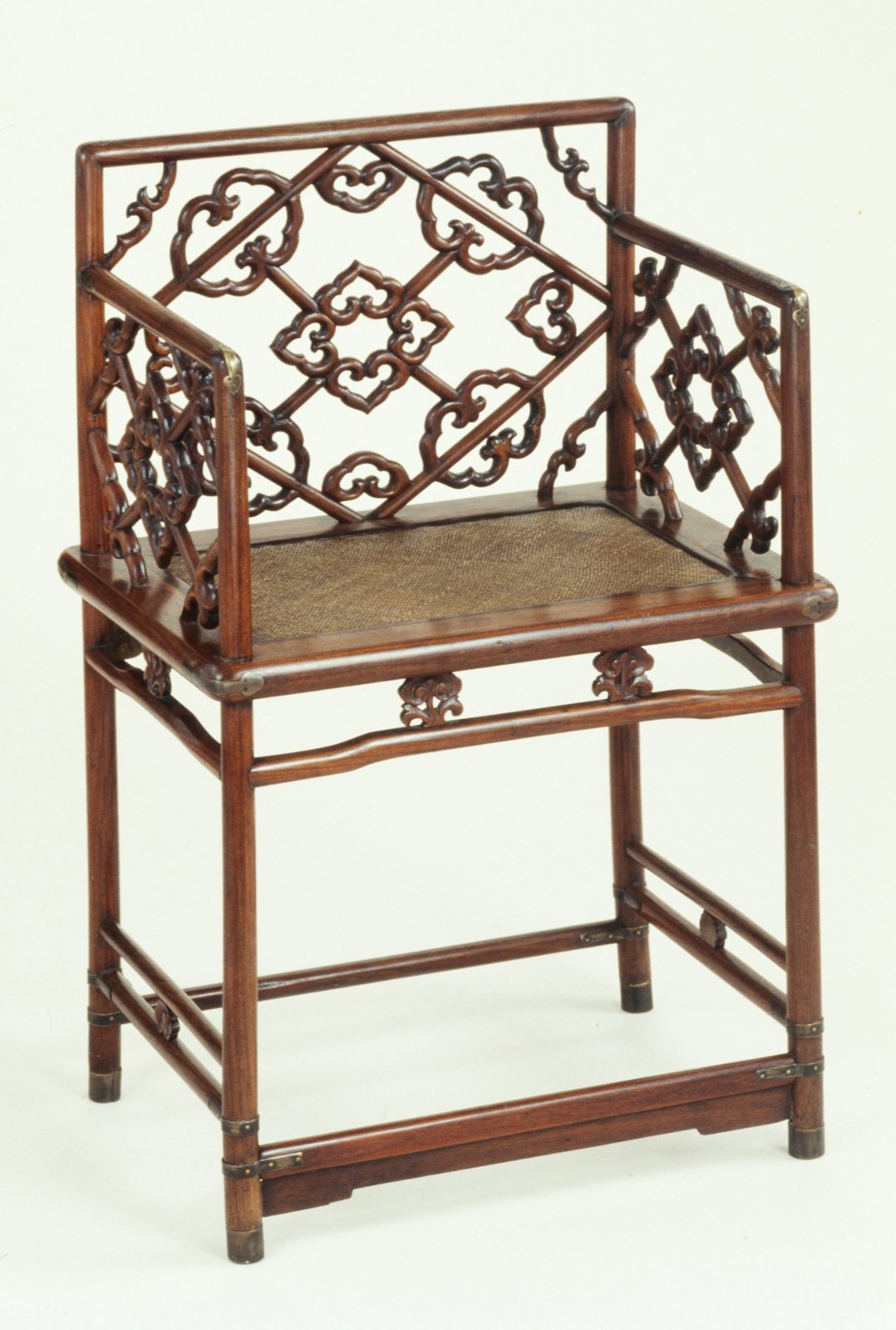
Minneapolis Institute of Art
Related joints
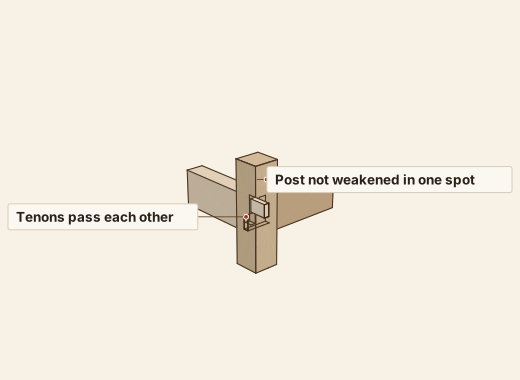
Big-In, Small-Out Tenon (大进小出榫)
Part blind, part through: a big tenon enters, a small one shows. It lets two stretchers share a leg without weakening it.
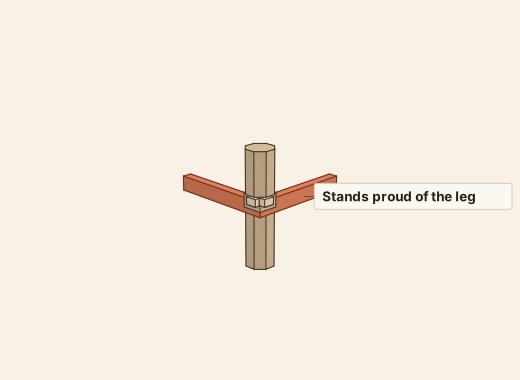
Wrap-Around Stretcher (裹腿枨)
Stretchers stand proud of a round leg and meet in a mitre at the corner, imitating bent bamboo.
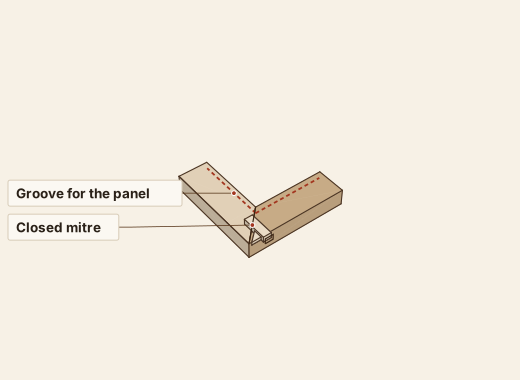
Mitred Frame Joint (格角榫)
The 45° corner of every Chinese frame-and-panel top: a tenon through the end plus a little triangular tongue.
Questions
What is a gejian joint?
A T-joint between rail and post where the rail’s outer face ends in a pointed mitred shoulder fitting a notch in the post.
What is the difference between large and small shoulders?
The small shoulder cuts the tip off the point, so less wood is removed from the post.
How can it help date or judge a chair?
Wang Shixiang found fine chairs use mitred shoulders on all four sides, rougher ones only on the front.