Ban Sun (半榫): The Blind Tenon That Keeps Chinese Furniture Faces Clean
Ban sun · 暗榫 · Stub tenon
Look closely at the front of a fine Ming table and you usually see no tenon ends at all. The joints are still there. They just stop short.
That is the ban sun, the half or blind tenon, the quiet workhorse of Chinese furniture.
- Chinese
- 半榫 · bàn sǔn
- Also called
- 暗榫, 闷榫 (in some usage)
- Joins
- Rail to post, leg to top
- Found in
- Show faces of chairs, tables and cabinets
- Opposite
- Through tenon (透榫)
How it works
Stops inside
The mortise, called a half-mortise (半眼), stops partway into the post, and the tenon is shorter than the post is deep. From outside nothing shows.
Neat on the show faces
Wang Shixiang notes that through tenons are stronger but blind tenons are neater, so tenons on the large show faces are mostly blind.
Everywhere, often unseen
Many famous joints are built from blind tenons. The two tenons of a long-and-short joint into a top frame are both blind, which keeps the tabletop clean.
How it's made
 Step 1
Shorter tenon
Cut the tenon shorter than the post is deep.
 Step 2
Half-mortise
Chop a mortise that stops inside the post.
 Step 3
Drive it in
Drive the rail in.
 Step 4
Nothing shows
The far face of the post stays clean.
 Step 5
Neat
Neater than a through tenon, a little less strong.
 Step 6
On the show faces
Fine pieces use it on the main faces.
Variations
Wedged blind tenon
A wedge inside the blind tenon spreads it as it is driven home; very strong but cannot be taken apart.
Related joints
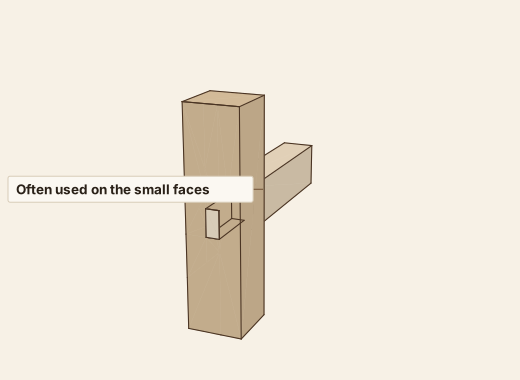
Through Tenon (透榫)
The tenon runs right through and its end grain shows on the far side: strong, but less neat than a blind tenon.
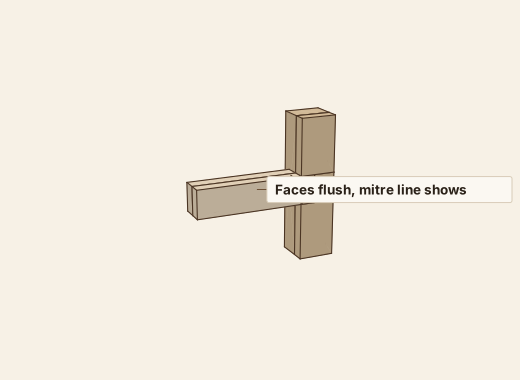
Mitred-Shoulder Joint (格肩榫)
Where a rail meets a post, its outer face is cut to a point that fits a matching notch, so mouldings meet cleanly.
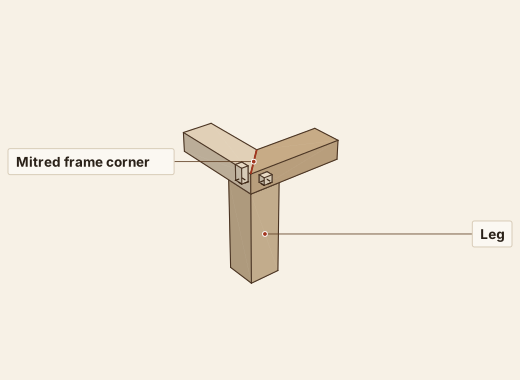
Long-and-Short Tenons (长短榫)
Two tenons at right angles on the top of a leg: a long one for the long side, a short one for the end.
Questions
What is a blind tenon?
A tenon that stops inside its mortise, so it can’t be seen from outside.
Why use it instead of a through tenon?
It keeps the show faces clean.
Is it weaker?
A little, which is why the small, hidden faces often use through tenons.