Zai Xiao (栽销): The Loose, Planted Tenon in Chinese Furniture
Zai xiao · 栽榫 · 桩头 · Loose tenon
Most Chinese tenons are cut from the end of the piece itself. Sometimes, though, there is nothing to cut one from, or the joint has to come apart again and again.
Then the maker plants a separate tenon. That is a zai xiao or zai sun, a loose tenon, “planted” like a stake.
- Chinese
- 栽销 · zāi xiāo
- Also called
- 栽榫, 桩头
- Joins
- Two parts, both mortised
- Found in
- Spandrels to aprons, couch-bed railings, detachable parts
- Related
- Zouma sliding pin
How it works
A separate tenon
Instead of cutting a tenon on one part, both parts are mortised and a separate piece of wood is made into the tenon and planted in.
Why
Popular science sources give two reasons: parts that are taken apart wear their tenons, and a planted tenon can be replaced without scrapping the part; and it saves cutting a tenon where the wood can’t spare it.
Where
Corner spandrels are often fixed to the apron with planted tenons (桩头). Couch-bed railings use them so the railings can be lifted off.
How it's made
 Step 1
Make the tenon
Make the tenon from a separate piece of wood.
 Step 2
Mortise one part
Mortise the first part.
 Step 3
Plant it
Plant the tenon into that mortise.
 Step 4
Mortise the other
Mortise the second part to match.
 Step 5
Bring together
Bring the parts together on the tenon.
 Step 6
Replaceable
A worn tenon can be replaced.
Variations
Sliding pin (走马销)
A dovetailed planted tenon that locks by sliding.
Spandrel pegs
Small planted tenons fixing corner spandrels.
Related joints
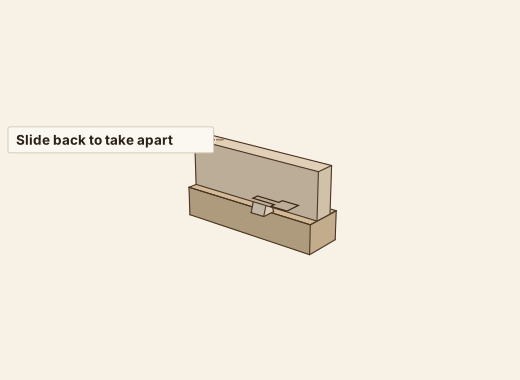
Sliding Locking Key (走马销)
A dovetailed key planted in one part drops into the wide end of a slot and slides to the narrow end to lock.
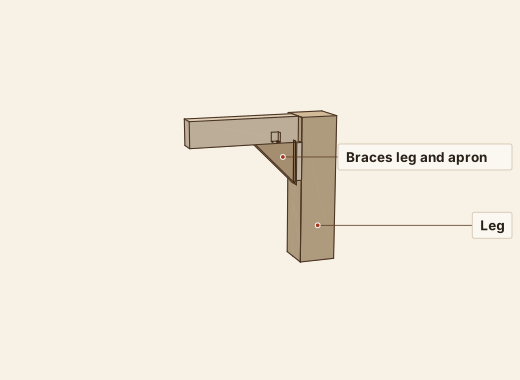
Corner-Bracket Joint (托角榫)
The small carved bracket under a table corner: tongued into a groove in the leg and pegged into the apron.
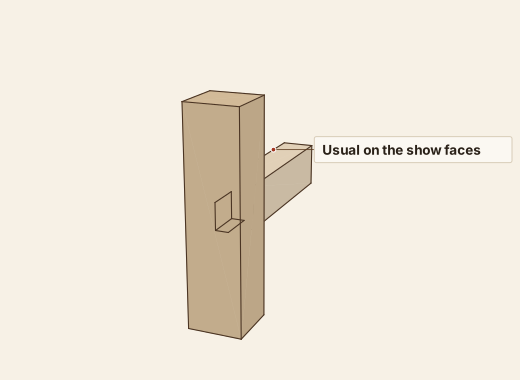
Blind Tenon (半榫)
The tenon stops inside the post, so nothing shows on the outside: neat, a little less strong than a through tenon.
Questions
What is a zai xiao?
A loose tenon: a separate piece planted into mortises in both parts.
Why not cut a normal tenon?
For detachable parts, so a worn tenon can be replaced, or where a tenon can’t be cut from the part itself.
Where is it used?
Spandrels, couch-bed railings and other detachable parts.