Wa Yandaiguo Sun: The Pipe-Bowl Joint of Southern Official’s Hat Chairs
Pipe-bowl joint · 烟袋锅榫
On a southern official’s hat chair the crest rail and arms don’t stick out past the posts. They curve down and seem to flow into them.
The joint behind that soft corner is named after a long tobacco pipe: wa yandaiguo, “hollowing the pipe bowl”.
- Chinese
- 挖烟袋锅榫 · wā yāndàiguō sǔn
- Joins
- Crest rail or arm to a post
- Found in
- Southern official’s hat chairs (南官帽椅)
- Signature parts
- Post tenon · down-turned, hollowed rail end
- Compare
- Four-cornered chairs, where the rail runs past the post
How it works
A tenon on the post
The top of the back leg (or the front post) is cut to a tenon.
A hollowed, turned-down end
The end of the crest rail or arm turns down and is hollowed out from below to take the tenon, like the bowl at the end of a pipe. Auction and museum descriptions of these chairs say the crest rail and arms join the back legs and front posts “by the pipe-bowl method”.
Why
The corner becomes one smooth curve with no projecting end. That is the difference between a southern official’s hat chair and a “four-cornered” one, whose rail and arms run past the posts.
How it's made
 Step 1
Post tenon
Cut a tenon on top of the post.
 Step 2
Turn the rail down
Shape the rail end to curve down.
 Step 3
Hollow it
Hollow a mortise into the end from below.
 Step 4
Set it on
Set the rail onto the post.
 Step 5
Smooth corner
A rounded corner, nothing sticking out.
 Step 6
Where
Typical of southern official’s hat chairs.
Variations
Arms
The arms join the front posts the same way.
Related joints
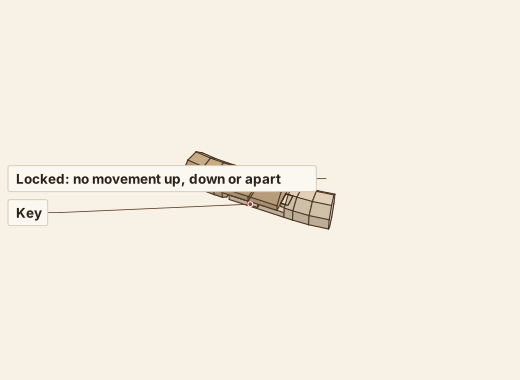
Wedged Scarf Joint (楔钉榫)
Curved pieces lapped with hooked tips and locked by a tapered key through the middle: how a horseshoe chair arm is built.
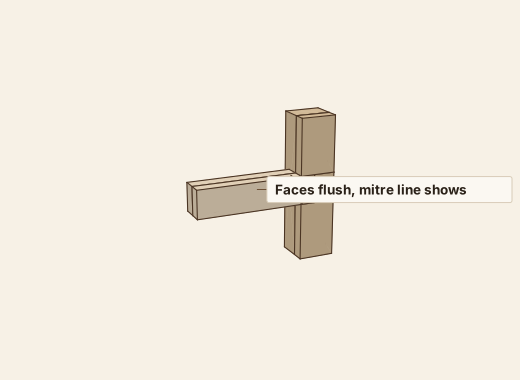
Mitred-Shoulder Joint (格肩榫)
Where a rail meets a post, its outer face is cut to a point that fits a matching notch, so mouldings meet cleanly.
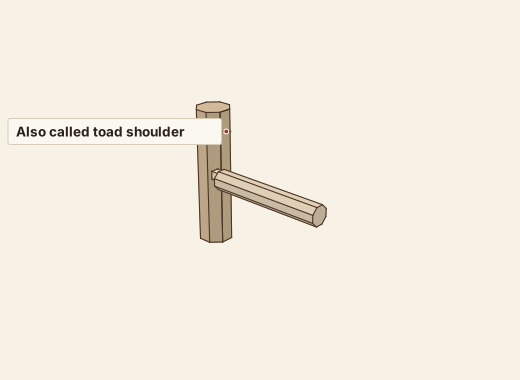
Flying Shoulder (飘肩)
Round stretcher flush with a round leg: tenon on the inner half, the outer half a shoulder that “floats” over the curve.
Questions
What is the pipe-bowl joint?
A rail end turned down and hollowed from below to sit on a post tenon, giving a rounded corner.
Which chairs use it?
Southern official’s hat chairs, whose crest rail and arms don’t project.
Why the name?
The hollowed, turned-down end looks like a tobacco-pipe bowl.