Piao Jian (飘肩): The “Toad Shoulder” Joint of Round Chinese Chair Legs
Toad shoulder · 蛤蟆肩
Where a round stretcher meets a round chair leg and their outer faces line up, the joint can’t have an ordinary shoulder.
Beijing makers called the solution piao jian, the flying shoulder, or the toad shoulder, because it looks like a toad’s open mouth.
- Chinese
- 飘肩 · piāo jiān
- Also called
- 蛤蟆肩 (toad shoulder)
- Joins
- Round stretcher to round leg, flush outside
- Found in
- Base stretchers of round-back armchairs and other round-leg pieces
- Compare
- Mitred shoulder for square stock
How it works
Flush outside
When the stretcher’s outer face lines up with the leg’s outer face (交圈), as with a round-back armchair’s base stretchers, Wang Shixiang explains that the tenon is left on the inner half of the stretcher end and the outer half is cut as a shoulder.
It floats
That leaves a large gap under the shoulder where it wraps the curve of the leg, so it seems to float. Hence “flying shoulder”, or “toad shoulder” for its open-mouth look.
When it isn’t flush
If the stretcher is set back from the leg’s face, both sides get shoulders and the tenon sits in the middle of the crescent-shaped end.
How it's made
 Step 1
Flush faces
The stretcher’s outer face lines up with the leg.
 Step 2
Inner-half tenon
Leave the tenon on the inner half.
 Step 3
Outer shoulder
Cut the outer half as a shoulder.
 Step 4
Mortise the leg
Mortise the round leg.
 Step 5
It floats
A large gap opens under the shoulder.
 Step 6
Toad shoulder
Its other name, for the open-mouth look.
Variations
Not flush
Shoulders on both sides and the tenon centred when the stretcher is set back.
In museum collections
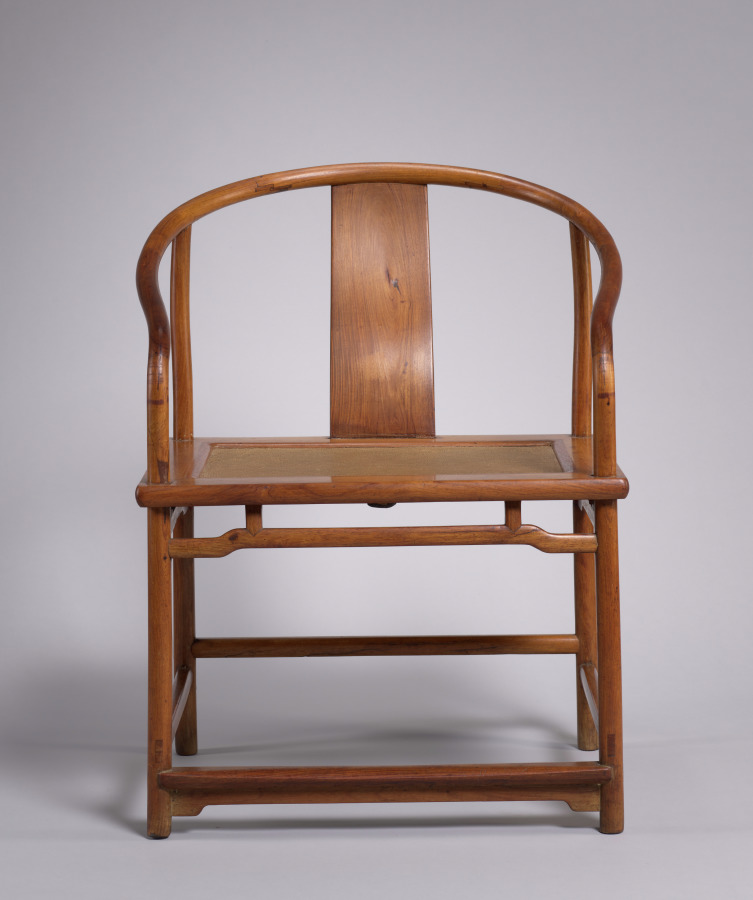
Cleveland Museum of Art
Related joints
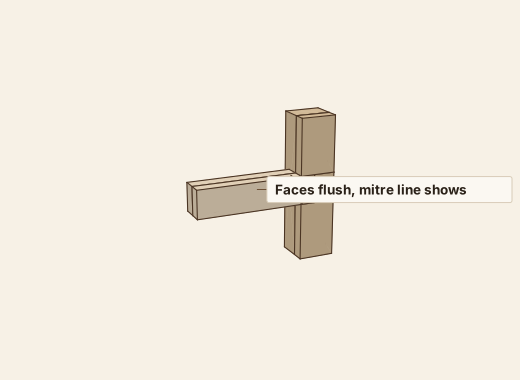
Mitred-Shoulder Joint (格肩榫)
Where a rail meets a post, its outer face is cut to a point that fits a matching notch, so mouldings meet cleanly.
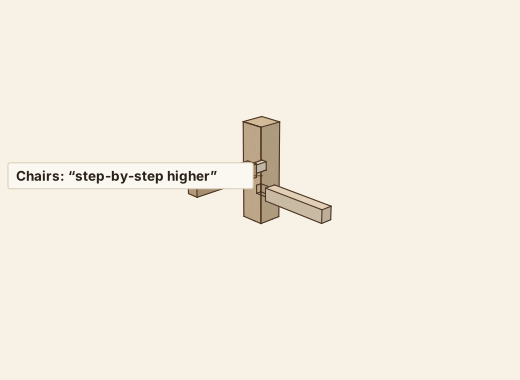
Staggered Stretchers (赶枨)
Stretchers from the front and side meet a leg at different heights, so their mortises never weaken it at one spot.
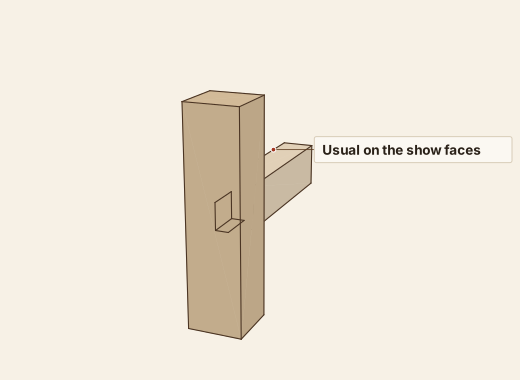
Blind Tenon (半榫)
The tenon stops inside the post, so nothing shows on the outside: neat, a little less strong than a through tenon.
Questions
What is a flying shoulder?
The joint of a round stretcher flush with a round leg: tenon on the inner half, shoulder outside.
Why “toad shoulder”?
The gap under the shoulder looks like a toad’s open mouth.
Where is it used?
Round-back armchair base stretchers and other round-leg furniture.