Qikou Sun (企口榫): The Shiplap Joint for Chinese Boards and Panels
Shiplap · 企口缝 · 裁口缝
Two boards butted edge to edge leave a gap you can see light through once the wood shrinks.
The qikou joint laps them instead: one of the oldest joints in China, already found in the Neolithic houses at Hemudu.
- Chinese
- 企口榫 · qǐkǒu sǔn
- Also called
- 企口缝, 裁口缝
- Joins
- Board edges
- Found in
- Thin boards, panels and boarding in buildings
- History
- Found among the 6,000–7,000-year-old timbers at Hemudu
How it works
Two rebates
Each board edge is rebated so half its thickness remains as a lip, one on the bottom and one on the top. Laid together the lips overlap and the faces are flush.
Why
When the boards shrink, the seam opens onto the lip below, not straight through. It is a face-to-face joint, one of the three broad families of Chinese joinery.
Very old
Rebated (qikou) joints are among the joint types found at the Hemudu site, alongside square tenons, round tenons and dovetails.
How it's made
 Step 1
Lower lip
Leave half the thickness as a lip on one board.
 Step 2
Upper lip
A matching lip on the other.
 Step 3
Lap
Lap them together.
 Step 4
No through gap
The seam never opens straight through.
 Step 5
Flush
Both faces flush.
 Step 6
Where
Thin boards and building panels.
Variations
Tongue and groove
A tongue in the middle of one edge fits a groove in the other.
Related joints
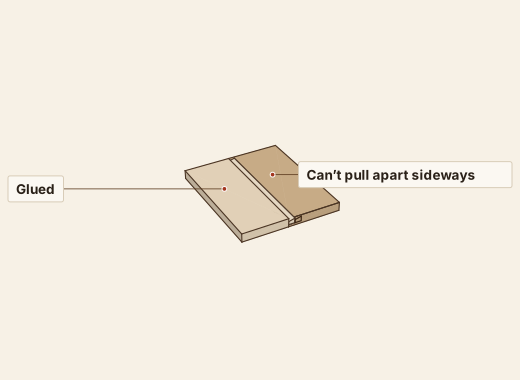
Longfeng Board Joint (龙凤榫)
A half-dovetail tongue on one board slides into a matching groove in the next, so the seam can neither step nor pull apart.
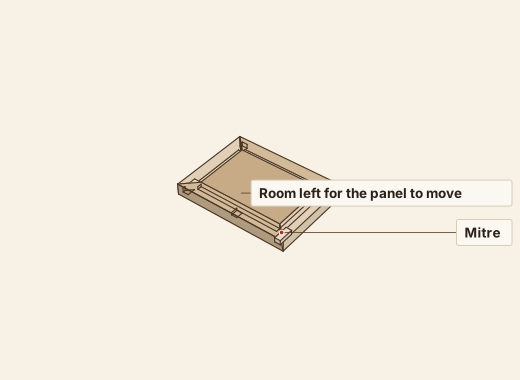
Frame and Floating Panel (攒边打槽装板)
A mitred frame grooved on the inside, a thin panel with a tongued edge floating in the groove, and battens underneath.
Questions
What is a qikou joint?
A shiplap: board edges rebated to overlap.
Why use it?
So shrinkage gaps don’t go straight through.
How old is it?
It appears among the Hemudu Neolithic timbers.