Longfeng Sun (龙凤榫): The Dragon-and-Phoenix Joint for Edge-Joining Boards
Longfeng sun · Dragon-and-phoenix joint
A Chinese tabletop panel is usually several thin boards. Glue alone would leave a seam that can step or open as the wood moves.
The answer has a poetic name: the longfeng sun, the dragon-and-phoenix joint. One edge carries a half-dovetail tongue, the other a matching groove, and the two are pushed together lengthwise.
- Chinese
- 龙凤榫 · lóngfèng sǔn
- Joins
- Thin boards edge to edge
- Found in
- Tabletop panels, cabinet panels; bargeboards in buildings
- Signature parts
- Half-dovetail tongue · matching groove
- Usually with
- Battens (穿带)
How it works
Half a dovetail
One board edge is planed to a long tongue whose section is half a silver ingot, half a dovetail. The neighbouring board gets a groove that is wider inside than at its mouth.
Pushed, not pressed
Because of that shape, the boards can’t simply be pressed together. They are slid together along their length (推插).
What it buys you
More glue surface, a seam that can’t step up or down, and boards that can’t be pulled apart sideways. Battens across the back then keep the whole panel flat.
How it's made
 Step 1
Plane the tongue
Plane a long tongue along one board edge.
 Step 2
Check the section
The tongue is half a dovetail: one face slopes outward.
 Step 3
Cut the groove
Groove the neighbouring board to match, wider inside than at the mouth.
 Step 4
Push together
Slide the boards together along their length.
 Step 5
Close the seam
The seam can no longer step up or down.
 Step 6
Glue and batten
Glue the joint; battens across the back keep the panel flat.
Variations
With battens
The classic Ming combination: longfeng joints plus battens (龙凤榫加穿带).
In buildings
Used on bargeboards, fascia boards and door boards.
Related joints
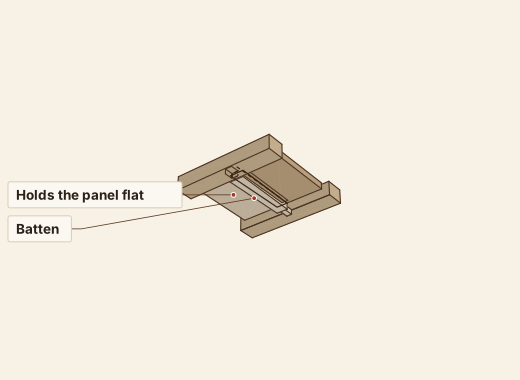
Sliding Dovetail Batten (穿带)
A tapered dovetail batten driven across the back of a panel, its ends tenoned into the frame: the reason old tabletops stay flat.
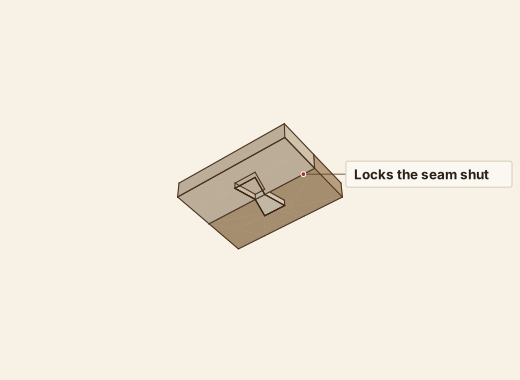
Butterfly Key (银锭榫)
A bow-tie key, two dovetails back to back, let in across a seam to lock thick boards together.
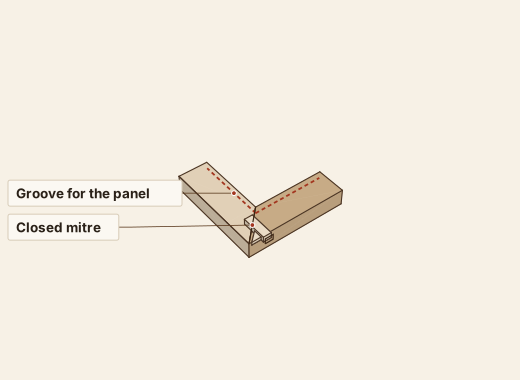
Mitred Frame Joint (格角榫)
The 45° corner of every Chinese frame-and-panel top: a tenon through the end plus a little triangular tongue.
Questions
What is a longfeng joint?
An edge joint for thin boards: a half-dovetail tongue on one edge slides into a matching groove in the other.
Why the name?
Dragon and phoenix are a traditional pair; the tongue and groove are a matched pair too.
Why not just glue?
The shape adds glue area, stops the seam stepping and stops the boards pulling apart sideways.