Yinding Sun (银锭榫): The Silver-Ingot Butterfly Key in Chinese Woodwork
Yinding sun · Silver-ingot key · Butterfly key · 银锭扣
Its Chinese name compares it to a silver ingot, the waisted bar of old Chinese money. In English workshops it is a butterfly or bow-tie key.
The yinding sun is two dovetails back to back, let into both boards across a seam. Neither board can pull away from the other.
- Chinese
- 银锭榫 · yíndìng sǔn
- Also called
- 银锭扣, 银锭条
- Joins
- Thick boards edge to edge
- Found in
- Bargeboards and boards in buildings; thick furniture boards
- Signature parts
- Double-dovetail key · matching recess
How it works
Two dovetails
The key is wide at both ends and narrow in the middle. A recess of the same shape is cut across the seam, half in each board, and the key is set in.
Where it’s used
Chinese builders use it to lock bargeboards, fascia boards and gable boards. One builders’ rule makes the key about a third to two-fifths as thick as the board.
Why fine furniture avoided it
Wang Shixiang notes that thick furniture boards were sometimes joined with ingot keys on the underside, like the waisted keys on ancient coffins, but fine pieces rarely used them because they spoil the clean face of the board.
How it's made
 Step 1
Prepare the boards
Joint the two thick boards edge to edge.
 Step 2
Mark the recess
Mark a bow-tie recess across the seam, half in each board.
 Step 3
Make the key
Make a key of the same shape: wide ends, narrow waist.
 Step 4
Set it in
Chop the recess and set the key in from the underside.
 Step 5
Thickness
The key is a fraction of the board’s thickness, about a third.
 Step 6
Locked
The seam can’t open.
Variations
In buildings
Common on bargeboards, fascias and gable boards.
On furniture
Occasionally under thick boards; fine pieces rarely used it.
Related joints
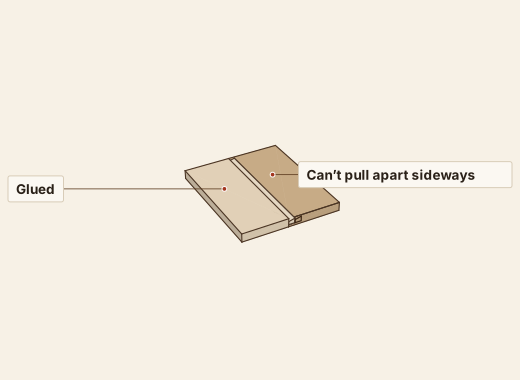
Longfeng Board Joint (龙凤榫)
A half-dovetail tongue on one board slides into a matching groove in the next, so the seam can neither step nor pull apart.
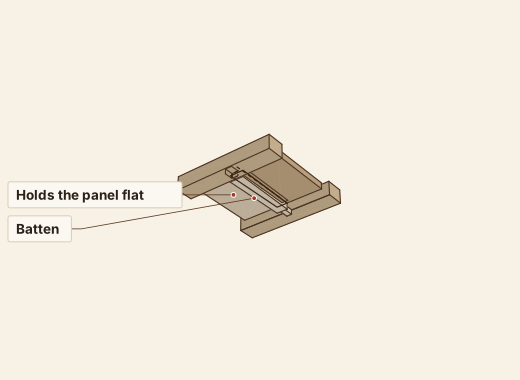
Sliding Dovetail Batten (穿带)
A tapered dovetail batten driven across the back of a panel, its ends tenoned into the frame: the reason old tabletops stay flat.
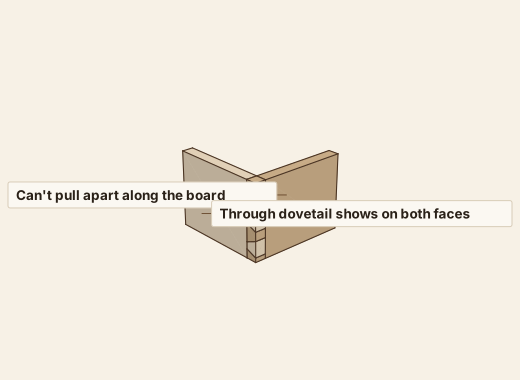
Dovetail Joint (燕尾榫)
A tenon wider at the tip than at the root, so it can’t pull out: found in boxes, drawers, tables and temple beams.
Questions
What is a yinding joint?
A double-dovetail key, shaped like a silver ingot, let in across a seam to lock two boards together.
Is it the same as a butterfly key?
Yes, it is the Chinese name for the same idea.
Why didn’t fine Ming furniture use it?
Wang Shixiang says craftsmen felt it spoiled the clean surface of the board.