Shizi Cheng: The Cross-Halving Joint in Chinese Furniture and Buildings
Cross halving · 十字卡腰 · 马蜂腰
When two pieces of wood have to cross in the same plane, neither can pass straight through the other.
Each gives up half instead. In furniture this is the shizi cheng (cross stretcher); in buildings, the shizi kayao, cross waist joint.
- Chinese
- 十字枨 · shízì chéng; 十字卡腰榫
- Also called
- 马蜂腰 (wasp waist) in building carpentry
- Joins
- Two members crossing in one plane
- Found in
- Crossed stretchers, lattices, crossing purlins and plates
- Related
- Wrapped stretchers
How it works
Half and half
One member is cut away by half its depth on top, the other by half on the bottom. Dropped together they cross flush and lock against sliding both ways.
In buildings
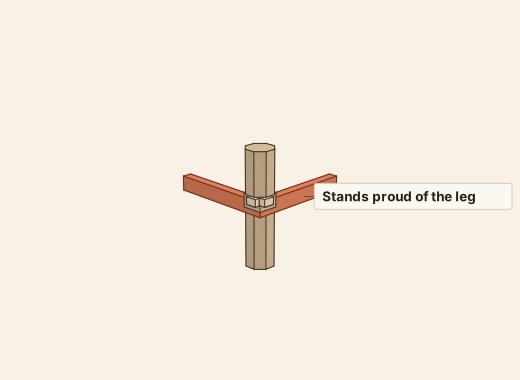
Crossing purlins at a corner and crossing plates use the same cross waist joint. Building manuals add a rule: the side member is laid over the front one (山面压檐面).
How it's made
 Step 1
Halve the lower
Cut half the depth from the top of one.
 Step 2
Halve the upper
Cut half from the bottom of the other.
 Step 3
Drop together
Drop one into the other.
 Step 4
Locked
The notches stop sliding both ways.
 Step 5
Flush
The faces are flush.
 Step 6
Where
Stretchers, lattices, purlins.
Variations
Purlins at corners
Crossing purlins with the ends running past.
Related joints
Questions
What is a cross-halving joint?
Two crossing members each notched half their depth so they fit flush.
Where is it used?
Crossed stretchers, lattices and crossing purlins.
Which goes on top in buildings?
The side member over the front one.