Men Sun (闷榫): The Fully Hidden Dovetail of Chinese Thick-Board Tables
Men sun · Blind mitred dovetail · 暗榫
Some Chinese low tables are made of just three thick boards: a top and two board legs. At each corner you see one clean diagonal line and nothing else.
Inside is a men sun, literally a “stuffy” or closed-in tenon: dovetails completely hidden behind a mitre.
- Chinese
- 闷榫 · mèn sǔn
- Also called
- 暗榫; modern woodworkers say 全隐燕尾榫
- Joins
- Thick boards at a corner; thin drawer sides
- Found in
- Board-leg kang and side tables, fine drawers, small boxes
- Signature parts
- Mitred outer skin · hidden dovetails
How it works
Three thick boards
Wang Shixiang describes kang and side tables made of three boards up to 4–5 cm thick. Where the top meets the board legs, every example he saw used a men sun: after closing, only one seam shows and all the joinery is hidden.
Dovetails inside
The corner is mitred on the outside. Behind the mitre, dovetails on one board fit sockets in the other, so the boards can’t pull apart.
Drawers too
The same idea, made finer, joins very thin drawer sides in small pieces such as document boxes and mirror stands. It is the most refined of the board-corner joints, above the open dovetail and the half-hidden one.
How it's made
 Step 1
Mitre the corner
The two thick boards meet at a mitre.
 Step 2
Cut hidden dovetails
Dovetails are cut inside the mitre, short of every outer face.
 Step 3
Cut the sockets
Matching sockets are cut inside the other board.
 Step 4
Slide together
The boards are slid together.
 Step 5
Skin covers all
The mitred outer skin hides every dovetail.
 Step 6
One seam
Closed up, only a single seam line shows.
Variations
Through dovetail
Both faces show the dovetails; Wang says only rough folk pieces used it on drawers.
Half-hidden dovetail
Shows on one face only.
Hooked mitre
A quicker look-alike for aprons that can work loose with age.
Related joints
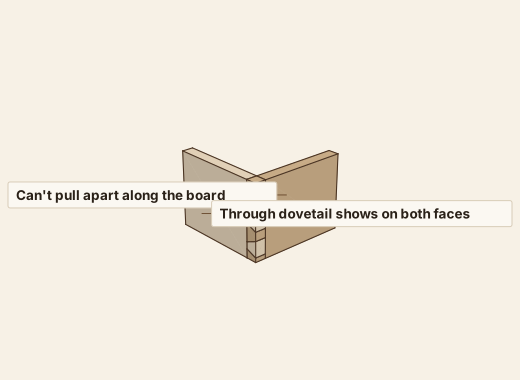
Dovetail Joint (燕尾榫)
A tenon wider at the tip than at the root, so it can’t pull out: found in boxes, drawers, tables and temple beams.
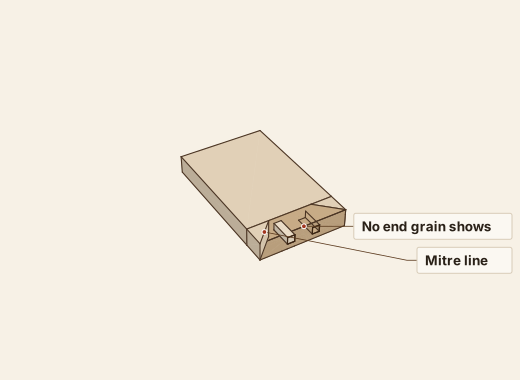
Breadboard End (拍抹头)
A cross-grain strip mitred and tenoned onto the end of a thick board: no end grain shows, and the board resists splitting.
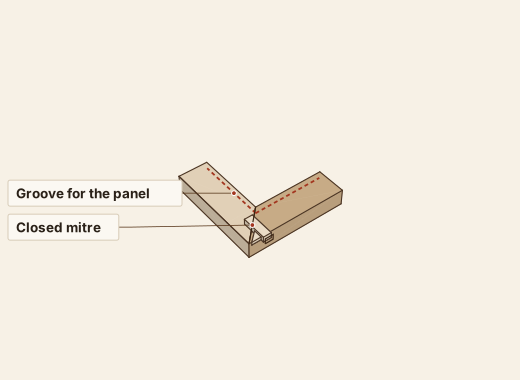
Mitred Frame Joint (格角榫)
The 45° corner of every Chinese frame-and-panel top: a tenon through the end plus a little triangular tongue.
Questions
What is a men sun?
A corner joint for boards with dovetails completely hidden inside a mitre, so only a seam line shows.
Where is it used?
Thick-board kang and side tables, and the drawers of fine small furniture.
How is it different from a normal dovetail?
A normal dovetail shows on one or both faces; a men sun shows nothing but the mitre.